
A power chair can give someone the freedom to visit family, attend appointments, enjoy a meal out, or take a weekend trip. But learning how to transport power chairs safely is just as important as choosing one that feels comfortable to drive. The right method protects the chair, the vehicle, and most importantly, the person who relies on it for everyday independence.
A compact folding chair may fit in a car trunk, while a larger reclining, off-road, or high-capacity model may require a vehicle lift or wheelchair-accessible van. There is no single transport solution for every chair. Start with the chair’s actual weight, folded dimensions, battery type, and your vehicle’s loading capacity.
Choose Transport Based on Chair Size and Vehicle
The most practical transport setup begins with an honest match between your power chair and your vehicle. Trying to force a heavy chair into a small sedan can lead to damaged equipment, back injuries, and stressful journeys before you have even left home.
Lightweight folding power chairs are often the easiest choice for drivers and families who use regular cars. Models made with carbon fiber, magnesium, or lightweight aluminum may fold into a compact shape that can fit in an SUV, hatchback, or larger trunk. Even then, check whether the chair can be lifted safely by the caregiver. A chair that weighs 40 pounds is very different from one that weighs 75 pounds once it must be lifted over a trunk lip.
Heavier power chairs, bariatric models, and chairs with reclining systems generally need more support. A rear-mounted vehicle lift, platform lift, or accessible van can make daily travel far safer and less physically demanding. These systems cost more than simply folding a chair into a trunk, but they can be worthwhile for frequent travel, especially when the user needs a chair with a higher weight capacity or advanced seating functions.
Measure before you buy equipment
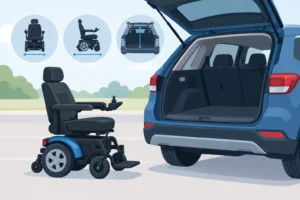
Before selecting a lift, ramp, or new vehicle, measure the chair at its widest and tallest points. Measure it both open and folded, if it folds. Include the footrests, joystick, headrest, and any accessories that may extend beyond the main frame.
Also check your vehicle’s cargo opening, interior height, and payload limit. Cargo space alone is not enough. A chair may physically fit in the trunk but still be too heavy for the vehicle, lift, or the people loading it. Your owner’s manuals for both the vehicle and chair should guide the final decision.
Transporting a Folding Power Chair in a Car
For many families, a folding power chair provides the best balance of independence and everyday convenience. It can be used for shopping, dining, medical visits, and travel without requiring a modified vehicle.
First, turn the chair off and remove the key if your model has one. Secure or fold the joystick, then fold the chair according to the manufacturer’s instructions. Do not force the frame closed if fabric, cables, or a loose accessory is caught in the mechanism.
If the battery is removable, taking it out can reduce the lifting weight and protect the battery from extreme heat inside a parked car. Keep the battery upright where possible, and avoid placing heavy bags on top of it. Some lithium batteries have specific handling instructions, so follow the guidance supplied with your chair.
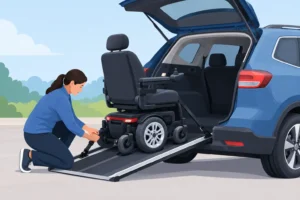
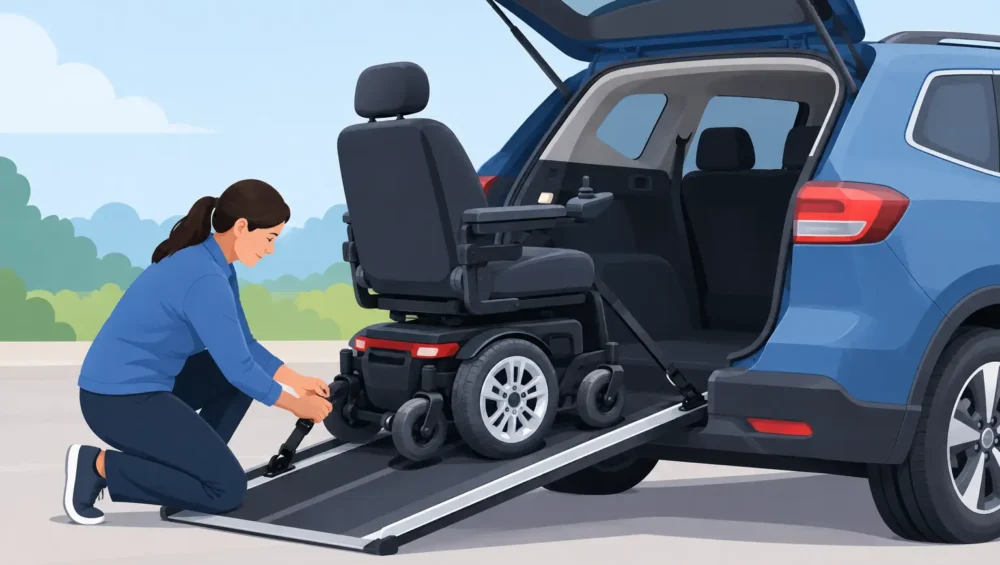
When loading, use your legs rather than your back and keep the chair close to your body. Two people should lift if the chair is awkward, bulky, or beyond a comfortable one-person weight. A portable ramp can reduce lifting, but it must be rated for the chair’s total weight, including battery and accessories.
Once inside the vehicle, the chair should not be free to roll or slide. Position it flat and secure it with rated tie-down straps connected to solid vehicle anchor points. Avoid attaching straps to moving parts, armrests, the joystick, or removable footplates. The chair should remain stable during braking, turns, and uneven road surfaces.
When a Vehicle Lift Is the Better Choice
A vehicle lift allows a power chair to travel without repeated lifting and folding. It can be a practical long-term investment for users of full-size power chairs or caregivers who should not be lifting heavy equipment.
Platform lifts carry the chair on an exterior or interior platform. They are convenient because the chair can usually stay assembled, but they add length and weight to the vehicle. Exterior lifts also expose the chair to rain, road dust, and heat, so a fitted weather cover is essential.
Hoist-style lifts use a powered arm to raise the chair into a trunk, SUV cargo area, or van. They keep the chair protected inside the vehicle, though they require enough interior clearance and a suitable mounting position. Some chairs must be partially disassembled or have the seat repositioned before loading.
For either system, check three ratings: the lift’s maximum capacity, the vehicle’s carrying capacity, and the chair’s actual travel weight. That travel weight includes batteries, cushions, bags, oxygen holders, and other accessories. A lift should never operate at or beyond its stated limit.
Secure the Chair for Every Journey
Securing a power chair is not only about preventing scratches. A chair can become a dangerous projectile in a sudden stop if it is not restrained correctly.
Use a purpose-designed docking system or four-point tie-down system when the chair is transported inside a van. Secure the frame at manufacturer-approved locations, with the chair powered off and the drive system in the recommended transport mode. Do not rely only on the parking brake.
If the passenger remains seated in the power chair while riding in an accessible vehicle, the setup requires additional care. The chair must be approved for occupied transport, and the vehicle must use an appropriate occupant restraint system. A standard lap belt around the wheelchair user is not a substitute for properly positioned vehicle-grade restraints.
For a chair stored in a trunk or cargo area, inspect straps before each trip. Replace straps with fraying, corrosion, damaged hooks, or unreliable buckles. It takes less than a minute to check them, and it can prevent a costly repair or injury.
Prepare the Battery for Road Trips and Flights
Battery preparation affects both safety and convenience. For road travel, charge the chair fully before leaving, then bring the correct charger. Avoid using an unapproved charger or plugging into questionable power sources, as this can damage the battery or controller.
Heat is a common concern. Never leave a power chair or loose battery in a vehicle for long periods during very hot weather. High temperatures can shorten battery life and may affect performance. If you are stopping for several hours, bring removable batteries indoors whenever practical.
Air travel has separate rules, especially for lithium-ion batteries. Airlines may limit battery size, require removable batteries to be carried into the cabin, or ask for terminals to be protected from short circuiting. Contact the airline before booking and again before departure. Provide the chair’s make, model, battery chemistry, watt-hour rating, weight, and folded dimensions.
At the airport, label the chair with your name and phone number. Carry clear instructions for placing the chair into freewheel mode, folding it, and protecting the joystick. Photographs of the chair before check-in can also help document its condition should damage occur during handling.
A Simple Pre-Trip Check
Before leaving, take a few minutes to confirm that the chair is charged, the tires are in good condition, and the joystick is protected. Bring the charger, key, any required tools, and a contact number for service support.
For longer journeys, it is wise to pack a small mobility kit with a tire pump if applicable, spare fuses if recommended for your model, a weather cover, and copies of battery information. These items are especially useful when traveling with a chair that is essential for daily movement.
If you are choosing a chair with transport in mind, test the full process before purchase. At a showroom, do more than sit in the chair. Fold it, lift it if appropriate, measure it against your vehicle, and ask how its battery and parts are supported. Vechair can help customers compare lightweight, compact, and higher-capacity designs with real transport needs in mind.
The best setup is the one that makes leaving home feel possible rather than complicated. When loading and securing the chair becomes a safe routine, every trip can begin with more confidence and less worry.