
Reclining Versus Standard Wheelchairs: Which Fits?CategoriesUncategorized

Reclining Versus Standard Wheelchairs: Which Fits?

A wheelchair can make a day feel more manageable – or more tiring. The practical difference between reclining versus standard wheelchairs often appears after several hours of sitting: during a meal, a car transfer, an afternoon appointment, or when a caregiver needs to reposition someone safely. The best choice is not simply the chair with more features. It is the chair that supports the user’s body, daily routine, and level of independence.

A standard wheelchair is often the right answer for active users who want a lighter, simpler chair for everyday movement. A reclining model can offer meaningful relief and care support for users who spend long periods seated or need help managing posture. Understanding the trade-offs helps families choose confidently rather than paying for features they may not use – or missing support they genuinely need.

Reclining versus standard wheelchairs: the core difference

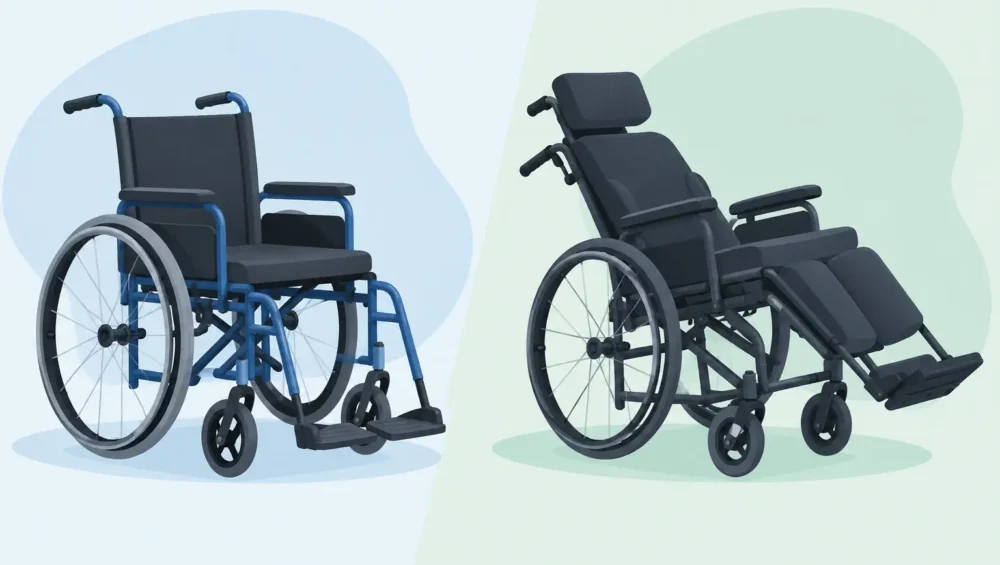
A standard wheelchair has a fixed backrest, typically positioned upright with a slight rearward angle. The user remains in one primary seated posture while moving, eating, working, and socializing. Many manual, transport, folding, lightweight, and electric wheelchairs follow this design because it keeps the frame compact, easier to maneuver, and easier to transport.

A reclining wheelchair has a backrest that moves backward, creating a more open hip angle. Depending on the model, the recline may be manually adjusted, gas-spring assisted, or powered through an electric control system. Some chairs also include elevating leg rests, which can create a more supported resting position.

That adjustment changes more than comfort. It can help distribute pressure, give the user a chance to rest, assist caregivers during personal care, and accommodate people who cannot comfortably stay upright for long. However, recline also adds mechanisms, chair weight, maintenance needs, and considerations around stability and positioning.

When a standard wheelchair is the better everyday choice

For many users, a standard wheelchair is the most practical option. Its straightforward design suits people who have reasonable trunk control, can sit upright comfortably, and need a chair mainly for errands, home mobility, work, school, or short outings.

A fixed-back chair usually feels more responsive when self-propelling. Because it has fewer moving parts, it may be lighter to push, lift into a vehicle, fold, or store. This matters for a family member loading the chair into a sedan, a user who travels regularly, or anyone navigating narrow hallways and elevators.

Standard wheelchairs can also support better daily independence when correctly fitted. A seat that is the right width and depth, footrests set to the right height, and armrests that suit transfers can make a major difference. An upright posture is often useful for eating, reaching a desk, operating a joystick, and joining conversations at eye level.

A standard chair may be especially suitable when the user:

  • Uses the wheelchair for shorter periods throughout the day
  • Has good head, neck, and trunk control
  • Prioritizes lightweight folding, car transport, or self-propulsion
  • Needs a compact chair for tight indoor spaces
  • Wants a lower-cost, lower-maintenance mobility solution

Simplicity is a benefit, not a compromise, when it matches the user’s needs. A well-fitted standard chair can feel secure, efficient, and freeing.

When reclining support can make a real difference

A reclining wheelchair is designed for a different kind of daily demand. It can be valuable for a person who spends many hours in the chair, becomes fatigued in an upright position, has limited postural control, or relies on a caregiver for repositioning.

Reclining changes the angle between the torso and thighs. For some users, that reduces discomfort at the hips and lower back. It may also make it easier to rest between activities without transferring immediately to a bed. If paired with elevating leg rests, recline can support users experiencing leg swelling, subject to guidance from their clinician.

For caregivers, the ability to recline can create a more manageable position for certain care tasks. It may help with clothing adjustments, hygiene routines, feeding support, or reducing the physical strain of trying to maintain an upright posture during care. A powered reclining wheelchair can be particularly helpful where the user can operate the controls independently, restoring a small but meaningful measure of control over comfort.

Still, recline is not automatically appropriate for every user. A person who slides forward in the seat when reclining may experience shear, where skin and underlying tissue move in different directions. This can increase skin risk if positioning is poor. The chair should have appropriate cushions, pelvic support, foot support, and head support when needed. Reclining is also not a substitute for regular pressure relief, skin checks, or clinical advice for users at risk of pressure injuries.

Comfort depends on positioning, not recline alone

It is easy to assume that a reclining wheelchair is always more comfortable. In reality, a poorly fitted reclining chair can be less comfortable than a properly fitted standard one.

Start with the basics: seat width should provide support without squeezing the hips or leaving excessive space; seat depth should support the thighs without pressing behind the knees; and footrests should prevent the feet from dangling. The backrest, cushion, armrests, and headrest must work together. A user with weak trunk control may need lateral supports or a contoured backrest, whether the chair reclines or not.

Cushion choice deserves equal attention. A pressure-relieving cushion may be necessary for someone who sits for prolonged periods, has reduced sensation, or has a history of skin breakdown. The cushion must be compatible with the chair’s seating system. A deep, soft cushion that feels pleasant for ten minutes may not provide stable posture for several hours.

If the user has complex postural needs, a therapist or qualified seating professional should be involved. The right wheelchair is a piece of mobility equipment, but it is also a seating system that affects breathing, digestion, fatigue, skin health, and confidence.

Consider transfers, transport, and the spaces you use

Daily logistics often decide the better chair. Ask how the user gets in and out of bed, transfers to a toilet, enters a vehicle, and moves around the home. A standard wheelchair with removable armrests and swing-away footrests may make side transfers easier. A reclining model can assist in some care situations, but its larger frame may be harder to position in a small bathroom or beside a bed.

Transport matters too. Reclining manual wheelchairs are generally heavier and bulkier than standard folding models. Powered recline adds battery-powered components and may increase overall weight further. If the chair will go into a car several times a week, confirm the folded dimensions, lifting weight, and whether a ramp, hoist, or accessible vehicle is needed.

For electric wheelchair users, check the full operational range of the seating functions. A chair may drive differently when reclined, and safety systems may limit speed or movement in certain positions. That is a useful protection, not an inconvenience. Stability has to come before convenience, particularly on slopes, uneven surfaces, or ramps.

Questions to answer before choosing

The most useful question is not, “Which wheelchair is better?” It is, “What does this person need to do comfortably and safely every day?” Consider how long the user will sit in the chair, whether they can reposition themselves, how much caregiver assistance is available, and where the chair will be used.

Also consider progression. A chair for a temporary injury may need only basic support and easy transport. A chair for a progressive condition may need room for changing needs, such as head support, pressure management, powered recline, or a higher weight capacity. Choosing for the next stage does not always mean purchasing the most complex model now, but it does mean avoiding a chair that will quickly become unsuitable.

A hands-on test is one of the most reliable ways to make the decision. Sit in the chair long enough to notice pressure points. Practice turning, braking, reaching, folding, and transferring where appropriate. If recline is being considered, test how the user feels at different angles and whether their body remains supported rather than sliding forward. Families should also test whether they can manage the chair’s weight and controls safely.

Choose the chair that supports the life around it

A standard wheelchair can deliver excellent mobility for a user who needs an upright, lightweight, practical solution. A reclining wheelchair can bring valuable comfort, positioning flexibility, and caregiving support for someone with longer seating needs or reduced postural endurance. Neither design is universally superior.

The right chair should make everyday moments feel less demanding: getting to the dining table, joining family outside, traveling to an appointment, or resting without losing participation. When a wheelchair fits the person and the routine around them, it becomes more than equipment. It becomes dependable support for moving forward with greater comfort and confidence.

Wheelchair Reviews That Lead to Better ChoicesCategoriesUncategorized

Wheelchair Reviews That Lead to Better Choices

A five-star rating can be reassuring, but wheelchair reviews are most useful when they describe a life that looks like yours. A lightweight folding chair praised by a frequent traveler may not be the right choice for someone who needs all-day seating support. A powerful outdoor model may feel excellent on uneven paths but be too large for a narrow apartment hallway.

The goal is not to find the chair with the most praise. It is to find evidence that a chair can make daily movement safer, more comfortable, and more independent for the person who will use it.

How to Read Wheelchair Reviews With Context

Start by looking at who wrote the review and how they use their chair. A review from an independent user, a spouse, an adult child, or a professional caregiver can each reveal something valuable. They also focus on different priorities. Users often notice ride comfort, joystick response, and confidence on slopes. Caregivers may be more concerned with folding, lifting, storage, transfers, and charging.

A useful review explains the situation behind the opinion. Look for details such as the user’s approximate weight, whether the chair is used indoors or outdoors, how often it is transported by car, and whether it is used for short outings or many hours at a time. Comments like “easy to use” or “very comfortable” are positive, but they do not tell you enough on their own.

Pay particular attention to reviews written after several weeks or months. First impressions can tell you whether a chair arrived in good condition and was simple to set up. Longer-term feedback is more likely to reveal battery behavior, seat comfort, tire wear, folding durability, and the quality of after-sales support.

Match Reviews to Your Daily Routine

The best mobility choice begins with your real routine, not a product category. Before comparing models, think through an ordinary day. Where will the chair be used? Who will move it in and out of the car? Are there thresholds, ramps, elevators, gravel paths, or crowded shopping areas to manage?

For a person who drives or travels with family, reviews of ultra-lightweight carbon or magnesium folding wheelchairs deserve close attention. Chair weight matters, but so does the shape and balance of the frame when it is lifted. A chair that folds compactly may still be awkward for one person to place in a trunk if it has no convenient lifting point.

For home-based daily use, maneuverability may matter more than top speed. Reviewers who mention turning in bedrooms, bathrooms, kitchens, and elevators offer practical information that specifications alone cannot provide. Measure narrow doorways and the space around the bed or dining table before assuming a compact-looking chair will fit comfortably.

Outdoor users need a different kind of evidence. Reviews should mention pavement cracks, ramps, grass, uneven sidewalks, and incline performance. An off-road or heavy-duty wheelchair can provide greater stability and traction, but larger wheels and a stronger frame often mean more weight and less convenience for car transport. There is no perfect compromise – only the compromise that best supports your daily life.

What Wheelchair Reviews Can Reveal About Comfort

Comfort is personal, which makes it one of the hardest areas to judge online. Still, detailed reviews can point you in the right direction. Look for comments about seat width and depth, back support, armrest height, footrest adjustment, vibration over uneven ground, and pressure after extended use.

A chair with a soft seat is not automatically the most supportive chair. For someone who spends many hours seated, posture, pressure distribution, and positioning may matter more than initial softness. Reclining models can help users rest, change position, or receive care more comfortably, but recline functions also add weight, mechanical complexity, and space requirements.

If transfers are part of the daily routine, read closely for comments about armrests, footrests, braking, and whether the chair stays steady when moving from a bed, sofa, or vehicle seat. A feature that sounds minor on a product page can make a meaningful difference in safety and caregiver confidence.

Compare the Specifications Behind the Comments

Reviews are strongest when they support, rather than replace, the technical details. Always compare the reviewer’s experience with the chair’s stated weight capacity, battery range, motor configuration, folded dimensions, and warranty terms.

Weight capacity should never be treated as an approximate suggestion. A bariatric or XL chair rated for higher payloads is designed with the frame, seat, motor, and stability needs of larger users in mind. Choosing a chair with enough capacity also helps protect ride quality and component life. Keep in mind that bags, oxygen equipment, and other carried items may contribute to the total load.

Battery range needs the same practical thinking. Manufacturer range estimates are generally measured under favorable conditions. A heavier user, hills, rough ground, frequent stops, tire pressure, and battery age can all reduce the distance available from one charge. Reviews that explain where and how the chair was used are more meaningful than a simple statement that the battery “lasts all day.”

For electric wheelchairs, pay attention to feedback about control response and braking. Smooth acceleration, predictable stopping, and a joystick that is easy to reach can build confidence for new users. For manual wheelchairs, reviews about push effort, wheel grip, brake placement, and frame weight are equally valuable.

Service Reviews Matter as Much as Product Reviews

A wheelchair is not a one-time purchase. It is equipment that may be used every day, so service access matters. Read reviews for signs that a supplier answers questions clearly, performs repairs, keeps common spare parts available, and explains warranty coverage without confusion.

This is especially important with folding mechanisms, controllers, chargers, batteries, tires, and motors. Even a well-built chair can need adjustment or replacement parts over time. A lower price can become less attractive if the seller cannot provide technical support when the chair needs attention.

Ask direct questions before buying: Who handles repairs? Are replacement batteries and chargers available? What is covered under warranty, and for how long? Can the chair be inspected or test-driven before purchase? At Vechair, the sales, service, and spare-parts approach is designed to give buyers support beyond the showroom decision, with warranty coverage for key electric components.

Watch for Review Red Flags

Not every negative review means a chair is poor. Sometimes it shows that the chair was a mismatch for the user’s needs. A complaint that a compact travel wheelchair is not comfortable for eight hours may be fair, yet it does not make the chair unsuitable for shorter outings and easy transport.

More concerning patterns include repeated reports of unstable braking, inaccurate product descriptions, unavailable parts, poor battery support, or no response when service is needed. Be cautious when reviews are extremely vague, unusually repetitive, or focused only on delivery speed rather than actual use.

Likewise, do not dismiss a product because of one isolated complaint. Look for patterns across several reviews and compare the circumstances. If several users of similar size and use needs report the same issue, that deserves attention.

Let a Test Drive Settle What Reviews Cannot

Online research can narrow the choices, but it cannot tell you how a chair feels through your hands and body. A proper test drive lets you check seat position, reach the joystick, practice turning, assess braking, and see whether the chair fits in a vehicle or home environment.

Bring the questions that came up while reading reviews. Test the folding mechanism if transport is important. Try a ramp if outdoor access is part of daily life. Ask whether adjustments can be made for armrests, footrests, cushions, and controls. For caregivers, it is worth practicing the tasks they will do most often instead of simply watching a demonstration.

The right wheelchair should not only meet a specification sheet. It should make the next trip to the store, family visit, medical appointment, or quiet afternoon at home feel more possible. Use reviews as a starting point, then choose the chair that gives everyday movement the confidence it deserves.

Scooter Chargers: Choose, Use, and Replace SafelyCategoriesUncategorized

Scooter Chargers: Choose, Use, and Replace Safely

A mobility scooter that stops halfway through a shopping trip or an appointment can take away more than a journey – it can take away confidence. Scooter chargers are a small but essential part of dependable daily mobility. The right charger protects the battery, supports reliable range, and helps your scooter stay ready when you need it.

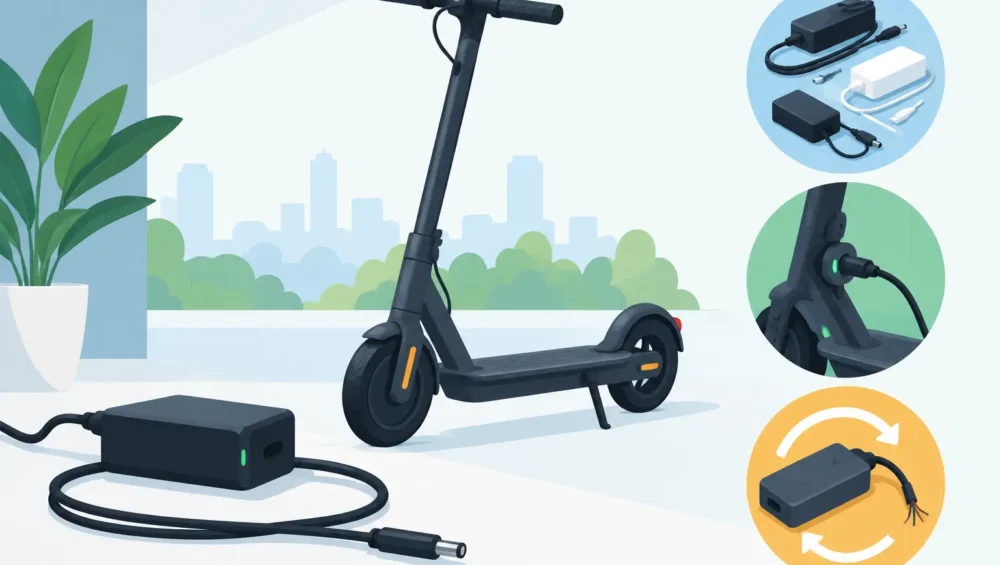
A charger is not simply a plug that puts power back into a battery. It must deliver the correct voltage, charging profile, connector fit, and current for your specific scooter. Choosing by appearance alone can lead to slow charging, damaged batteries, reduced range, or a scooter that will not power on at all.

Choosing scooter chargers for your mobility scooter

Start with the information label on your existing charger, scooter, or battery pack. The model manual is also useful, especially when the original charger is missing. The most important specification is the battery system voltage. Many mobility scooters use a 24-volt system, usually made from two 12-volt batteries, but this is not universal. A charger must match the scooter’s required system voltage exactly.

Battery chemistry matters just as much. Traditional mobility scooters often use sealed lead-acid batteries, typically AGM or gel batteries. Newer lightweight scooters may use lithium batteries. These battery types require different charging behavior. A lithium battery charger may have built-in communication or a battery-management requirement, while a lead-acid charger follows a different multi-stage charging pattern. A charger that fits the socket is not automatically compatible.

The connector also needs close attention. Charging ports can look similar while having different pin layouts or polarity. Never force a connector, modify a plug, or assume an adapter makes two systems safe to use together. If the plug does not seat firmly and naturally, stop and confirm compatibility with a qualified mobility technician.

Why charger amperage affects charging time

A charger’s output current, measured in amps, influences how quickly the battery can recharge. A higher-amp charger can shorten charging time, but only when the scooter manufacturer approves it. Too little current may mean a very long charge. Too much current can create unnecessary heat and place stress on a battery, wiring, or charging port.

For many users, the best choice is the approved replacement charger supplied for that scooter model. It is designed around the battery capacity, electrical system, and connector arrangement. This is especially worthwhile for scooters used every day, for users who depend on consistent range, and for caregivers who need a routine they can trust.

What a good charging routine looks like

Recharge your scooter after a meaningful day of use rather than waiting until the battery is completely flat. Deep discharges are hard on many battery types, particularly lead-acid batteries. If your scooter is used daily, charging overnight in a safe, ventilated location is often the most practical routine.

Park on a level surface, switch the scooter off, and make sure the charger cable is not stretched across a walkway. Connect the charger according to the scooter instructions, then plug it into a suitable wall outlet. Some models specify the reverse order, so follow the guidance for your own scooter rather than relying on a general rule.

Most modern chargers use indicator lights. A red or amber light commonly shows that charging is in progress, while green usually means the battery has reached full charge or maintenance mode. Light colors are not standardized across every brand, so treat the charger label and manual as the final authority.

Avoid charging in direct sun, near a heater, beside flammable materials, or in a wet area. A garage or covered utility space can work well if it stays dry and has normal airflow. Batteries and chargers naturally create some warmth while operating, but they should never become painfully hot to touch, smell burnt, hiss, leak, or swell. Disconnect power and arrange an inspection if any of these warning signs appear.

Do not interrupt every charge too early

A short top-up can be useful before an unexpected outing, but repeatedly unplugging a scooter before its charging cycle finishes may leave the battery undercharged. With lead-acid batteries, that habit can contribute to sulfation, a condition that gradually reduces capacity. The scooter may still show a full battery light at first, yet lose range quickly once you are outdoors.

At the same time, leaving an unsuitable or faulty charger connected indefinitely is not protective. A properly matched smart charger should reduce or stop active charging when the battery is full. If you are unsure whether a charger has a maintenance mode, ask a mobility specialist before making long-term connection part of your storage routine.

Charging a scooter that is not used often

Mobility needs can change from week to week. A scooter may stay parked while someone recovers from surgery, travels with family, or uses a wheelchair indoors. Batteries still lose charge while sitting, and neglected batteries can fail long before their expected service life.

For short periods of non-use, keep the scooter and charger in a dry location and follow the manufacturer’s storage schedule. Many scooters benefit from being charged at least once every few weeks. Lithium systems may have different storage recommendations, often favoring a partial charge rather than being stored at 100 percent for months. This is one reason it is essential to know which battery type your scooter uses.

If the scooter will be stored for a long period, inspect the batteries, cables, tires, and charger before returning it to service. A full charge does not guarantee the battery can still hold capacity under load. A test drive close to home is a sensible first check.

When scooter chargers need attention or replacement

A dead scooter is not always caused by the charger. Battery age, loose terminals, a damaged charging port, a blown fuse, or a controller issue can produce similar symptoms. Still, there are common signs that point toward the charger.

A charger may need professional testing or replacement when its power light never comes on, its charging light never changes after an appropriate charging period, the fan runs unusually loud, the cable is frayed, the plug is loose, or the casing becomes excessively hot. Visible cracks, a burning smell, discoloration around the plug, and intermittent charging are all reasons to stop using it immediately.

Do not try to repair a charger with tape, exposed wire splices, or an improvised plug. Mobility scooters carry substantial electrical current, and a poor repair can damage expensive batteries or create a shock and fire risk. A correctly specified replacement is the safer and more cost-effective decision.

When ordering a new charger, have the scooter make and model, battery chemistry, voltage, connector type, and original charger output available. A clear photo of the charger label can also help a service team confirm the match. If your scooter is still under warranty, check whether the charger is covered before purchasing a replacement. At Vechair, chargers are supported by a one-year warranty, alongside specialist service and replacement-parts guidance.

Protecting battery range between charges

Charging habits are only part of the picture. Range also changes with rider weight, hills, tire pressure, surface type, temperature, and the age of the battery. A scooter that manages a long distance on smooth indoor floors may cover considerably less ground on sloped pavements, rough paths, or grass.

Keep tires inflated to the recommended pressure, avoid carrying more than the scooter’s rated capacity, and plan longer trips with terrain in mind. If range has dropped noticeably despite full charging, do not assume a new charger will solve it. The batteries may be nearing the end of their service life, or the scooter may need a broader electrical inspection.

The most reliable mobility routine is simple: use the charger designed for your scooter, give the battery enough time to charge fully, and respond early when performance changes. That small amount of care helps keep every planned outing within reach.

Medical Device Certification Guide for WheelchairsCategoriesUncategorized

Medical Device Certification Guide for Wheelchairs

A wheelchair is not simply a seat with wheels. It may be the difference between staying home and joining family outings, moving safely through a workplace, or keeping a daily routine without relying on someone else for every transfer. This medical device certification guide explains what certification can tell you, what it cannot tell you, and how to use it when selecting an electric wheelchair or mobility device.

Certification matters because mobility equipment carries real responsibility. A chair that is poorly matched, inadequately supported, or not compliant in its intended market can create avoidable risks for the user and the caregiver. Still, a certification label should begin your questions, not end them.

What Medical Device Certification Means

Medical device certification is a broad phrase. In practice, the exact process depends on the country where a device is sold, its intended use, and its risk category. A lightweight folding power wheelchair, for example, is evaluated differently from a hospital bed, transfer hoist, or a device designed to support a higher-weight user over uneven terrain.

For consumers, certification generally indicates that the product and the business supplying it are operating within a recognized medical-device regulatory framework. This may involve documented safety and performance requirements, traceability, labeling rules, complaint handling, and post-market monitoring. It is meaningful reassurance, especially when a device will be used every day.

However, certification is not a promise that every chair is right for every person. It does not tell you whether the seat depth fits, whether the suspension suits rough sidewalks, whether the folded size fits your car, or whether the controller is comfortable to use with reduced hand strength. Those decisions still require a close look at the product and, whenever possible, a test drive.

Certification Is Not the Same as Product Quality Alone

A compliant device can still be a poor choice if its specifications do not match the user’s lifestyle. An ultra-light carbon or magnesium chair may be excellent for frequent car travel, but a heavier off-road model may offer more confidence on sloped driveways, grass, and uneven surfaces. A compact folding design saves space, while a reclining chair may better support users who spend longer periods seated.

Think of certification as the foundation. Fit, comfort, battery range, terrain capability, service access, and caregiver needs are the layers built on top of it.

A Medical Device Certification Guide by Market

Regulatory wording can be confusing because a device may be sold across several countries. Always check the requirements that apply where the device will be used and serviced.

In the United States, medical devices are regulated by the Food and Drug Administration. Depending on the classification, a product may be subject to registration and listing requirements, and some devices require premarket review or clearance. Terms such as “FDA registered” and “FDA cleared” do not mean the same thing, so ask the seller to explain the claim precisely.

In Malaysia, medical devices are regulated by the Medical Device Authority, commonly called the MDA. A supplier should be able to explain how its products are placed on the Malaysian market and what its certification or registration statement refers to. If you are purchasing for use in Malaysia, this is particularly relevant because it connects the device to the local regulatory and support environment.

For buyers in Singapore, Thailand, Brunei, or elsewhere, do not assume that approval in one market automatically replaces local requirements in another. Cross-border purchases can look attractive at first, but warranty service, parts availability, battery transport rules, and local compliance can become more difficult afterward.

What to Check Before You Buy

Start by asking the seller for clear, plain-language answers. You should not need to decode vague claims or rely on a logo in a product image. A dependable mobility specialist can explain the device category, the applicable certification or registration, and the documentation available for that model.

Look closely at the product label and manual. The model name should match the chair you are considering, including major configurations such as battery type, reclining function, or weight capacity. If a chair is advertised as supporting 440 pounds or 200 kg, ask whether that figure includes personal belongings and whether the recommended use changes on slopes or rough terrain.

Battery details deserve particular attention. Battery range is influenced by user weight, hills, tire pressure, temperature, driving style, and battery age. A stated range is a useful comparison point, not a guarantee that every trip will cover the same distance. Ask what battery chemistry is used, how long charging takes, and whether a replacement battery is available locally.

The same practical approach applies to the motor, controller, brakes, tires, and folding mechanism. A beautiful, modern chair is valuable only if it remains dependable after repeated daily use. Check the warranty period, what is covered, who performs repairs, and whether common spare parts can be obtained without a long wait.

Why Local Service Is Part of Safety

A mobility device needs care long after delivery day. Tires wear, batteries lose capacity, controllers can be damaged, and folding mechanisms need adjustment. For this reason, after-sales service is not an optional extra. It is part of the ownership decision.

Ask whether the supplier has trained technicians, a service center, and replacement parts for the specific chair. A seller that can provide sales, repairs, and spare parts offers a more complete safety net than one that only ships a boxed product. For a caregiver, this can prevent a minor fault from becoming a long period without essential mobility.

Vechair supports this approach through its sales, service, and spare-parts model, with guided showroom test drives for customers who want to compare a compact travel chair against a reclining, heavy-duty, or off-road option in person.

Match the Certified Device to the Person

The best chair is based on how it will actually be used. A user who transfers independently may prioritize armrest height, seat stability, and controls that are easy to reach. A caregiver may need a chair that folds quickly, fits into a trunk, and has manageable lifting weight. For someone with changing physical needs, recline, head support, pressure management, and transfer compatibility may matter more than a very low chair weight.

Test driving is valuable because specifications cannot show everything. During a demonstration, try starting and stopping, turning in a confined space, moving over a doorway threshold, and folding or dismantling the chair if that is part of your routine. Check whether your feet, knees, back, and arms are supported naturally. If the chair feels difficult in a controlled setting, it will not become easier in a crowded parking lot or on a rainy day.

For heavier users, never treat a published maximum capacity as the only measurement. Confirm seat width, frame stability, suspension, tire choice, and the conditions in which the chair will be driven. A bariatric model built for higher capacity can be the safer and more comfortable option, even if it is less compact for transport.

Warning Signs Worth Taking Seriously

Be cautious when a seller cannot identify the exact model, avoids questions about regulatory status, or makes broad medical claims without documentation. Other warning signs include unclear warranty language, no repair pathway, no battery information, and a price that seems unusually low because service and parts have been left out of the equation.

You should also be careful with devices marketed as both medical equipment and high-speed personal transport. Intended use affects where and how a device can be operated. Confirm local rules, especially if you expect to use it on public roads, in shopping centers, or while traveling by air.

A well-chosen wheelchair should feel like a reliable part of life, not another source of uncertainty. Ask for evidence, test the fit, and choose a supplier that will still answer the phone when your chair needs attention months or years from now.

Top Bariatric Wheelchair Safety FeaturesCategoriesUncategorized

Top Bariatric Wheelchair Safety Features

A bariatric wheelchair should do more than state a higher weight limit. The top bariatric wheelchair safety features work together to support the user’s body, control the chair on real surfaces, and give families confidence during everyday movement. A chair that feels stable in a showroom but shifts on a driveway, struggles at a doorway, or lacks the right seating support is not the right long-term solution.

For larger users, safety begins with honest measurements and continues with the details that are easy to overlook: the width of the seat, the chair’s overall footprint, battery placement, braking performance, and the availability of service when a part needs attention. The best choice depends on where the chair will be used, who will assist the user, and whether it needs to travel by car.

A Rated Capacity With a Real Safety Margin

A listed maximum user weight is the first figure most buyers compare, but it should not be the only one. The rating should reflect the complete chair as supplied, including its seating system and standard components. It also needs to account for what the user carries each day, such as a phone, medical items, shopping, or an oxygen device.

For example, a chair rated to 440 pounds may be suitable for a user well below that limit, while someone close to the maximum may need a higher-capacity model to allow a sensible operating margin. This is not about buying more chair than necessary. It is about avoiding excess stress on the frame, motors, tires, brakes, and battery system.

Ask for the manufacturer’s rated capacity rather than relying on a verbal estimate. Do not assume that a wider seat automatically means a higher weight rating. Seat width and structural capacity are related, but they are not the same specification.

Frame Design That Resists Flex and Instability

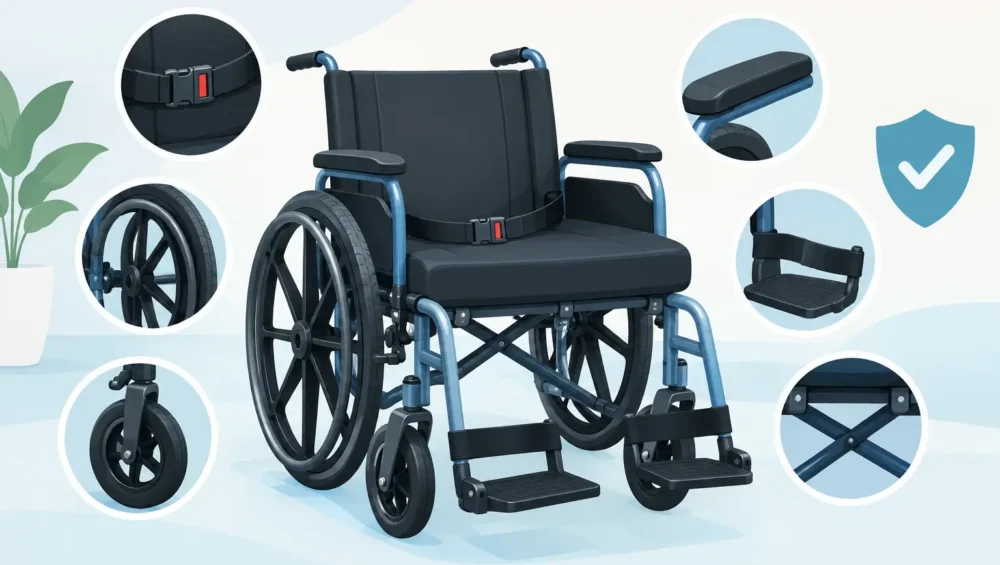
A high-capacity wheelchair needs a frame engineered for the load, not simply reinforced with a larger seat. Look for a sturdy cross-brace or chassis structure, secure welding, and reinforced mounting points where the wheels, footrests, armrests, and seat connect. On powered models, the motor housings and suspension components should also be designed for the stated capacity.

Frame material matters, but it is not a shortcut to safety. Steel can provide reassuring strength and durability, while aluminum, magnesium, and other modern materials may reduce the chair’s weight for transport. The safer option is the one with a proven load rating, stable geometry, and appropriate construction for its intended terrain.

A test drive is especially useful here. Notice whether the chair feels planted when turning, starting, stopping, and moving across slight changes in surface level. A well-designed chair should not feel loose, twist noticeably, or require constant correction from the user.

Seat Width, Depth, and Pressure Support

A seat that is too narrow can create painful pressure at the hips and thighs. A seat that is excessively wide may reduce posture control and make transfers harder. The right width allows room for normal clothing and movement without squeezing the user or leaving them unsupported.

Seat depth matters just as much. The cushion should support the thighs while leaving clearance behind the knees. If the seat is too short, body weight may concentrate in a smaller area. If it is too deep, the user may slide forward or experience pressure behind the knees.

For people who spend many hours seated, a pressure-relieving cushion, adjustable backrest, and correctly positioned armrests can be safety features, not luxuries. Better posture helps reduce sliding, skin stress, fatigue, and the risk of an unsafe transfer. A reclining function can improve comfort for some users, but it changes the chair’s center of gravity, so it should be used according to the manufacturer’s guidance.

Stability Starts at the Wheels and Base

A wheelchair’s footprint plays a major role in preventing tip risk. Wider wheel spacing and a longer wheelbase can improve stability, particularly for outdoor use or users who need a larger seat. The trade-off is that a larger chair may be less convenient in narrow hallways, compact elevators, and small bathrooms.

Anti-tip wheels are one of the most practical bariatric wheelchair safety features. They help limit rearward tipping when traveling uphill, navigating ramps, or shifting weight during transfers. They are valuable, but they are not permission to climb steep slopes or curbs beyond the chair’s stated limits.

Wheel and tire selection also deserves attention. Larger drive wheels can handle uneven outdoor surfaces more confidently, while solid tires reduce puncture concerns and pneumatic tires can offer a softer ride. Pneumatic tires require regular pressure checks. Underinflated tires can affect steering, braking, range, and stability, especially under a heavier load.

For powered chairs, consider whether the drive configuration suits the environment. Mid-wheel drive can offer a tight turning radius indoors. Rear-wheel drive may feel more predictable at speed and on longer outdoor routes. Front-wheel drive can manage some obstacles well, but its handling characteristics differ. There is no single best setup for every user.

Brakes, Controls, and Powered Chair Protection

On a manual bariatric chair, attendant brakes should be easy for a caregiver to reach and strong enough to hold the chair during transfers. Wheel locks are designed to stabilize the chair while stationary. They should not be used to slow a moving wheelchair.

Powered bariatric wheelchairs need dependable electromagnetic brakes that engage when the joystick is released. The controller should allow the speed to be set appropriately for the user’s reaction time, confidence, and environment. Slower indoor settings can make doorways and crowded spaces easier to manage, while outdoor speed should still leave enough stopping distance for slopes and pedestrians.

A responsive joystick, clear battery display, and low-speed programming are valuable safety aids. So are secure cable routing and protected electronics, particularly if the chair will be used outdoors. For users with limited hand control, alternative controls or caregiver attendant controls may be safer than forcing a standard joystick arrangement.

Battery Placement and Range Planning

A heavier user, frequent hills, rough ground, cold weather, and a reclined seating position can all affect battery range. A larger battery does not remove the need for planning, but it can provide useful reserve capacity for longer days.

The battery should be securely mounted, protected from impact, and charged with the correct approved charger. Do not stretch extension cords across walkways or charge where moisture and heat are present. Families should also know what a low-battery warning looks like and avoid starting a long trip with an uncertain charge.

Transfer Safety Is Part of the Chair Choice

Many incidents occur not while driving, but while getting into or out of the wheelchair. A good bariatric chair supports safe transfers with stable wheel locks, removable or swing-away footrests, armrests suited to the transfer technique, and a seat height that works with the user’s bed, toilet, sofa, or vehicle.

A transfer board, gait belt, or hoist may be appropriate depending on the person’s strength and balance. The right equipment should be selected with professional advice when needed. Caregivers should never pull a person up by the wheelchair armrests or rely on the footplates for support. Footplates are for the feet, not for standing weight.

Before any transfer, turn the power off on an electric chair, engage the brakes where applicable, move footrests clear, and position the chair close to the destination surface. These small habits protect both the user and the caregiver.

Daily Checks and Local Service Support

Even a well-built wheelchair needs routine attention. Before use, check that tires are in good condition, wheel locks or brakes hold firmly, the seat and armrests are secure, and there are no unusual noises, loose fasteners, or damaged cables. On electric models, inspect the charger connection and confirm that the battery indicator is behaving normally.

Service support is a safety feature in practical terms. A chair is only dependable if replacement tires, controllers, batteries, brakes, and other parts can be inspected or replaced when needed. Vechair’s sales, service, and spare-parts approach is designed for this reality, giving users a place to compare configurations, test-drive suitable options, and seek support after purchase.

A bariatric wheelchair should feel secure before it feels impressive. Take measurements, test the chair in the spaces that matter, and choose capacity, seating, and control features that fit the user’s actual routine. The right chair can make daily movement feel less like a risk to manage and more like independence returning.

How to Transport Power Chairs Safely by CarCategoriesUncategorized

How to Transport Power Chairs Safely by Car

A power chair can give someone the freedom to visit family, attend appointments, enjoy a meal out, or take a weekend trip. But learning how to transport power chairs safely is just as important as choosing one that feels comfortable to drive. The right method protects the chair, the vehicle, and most importantly, the person who relies on it for everyday independence.

A compact folding chair may fit in a car trunk, while a larger reclining, off-road, or high-capacity model may require a vehicle lift or wheelchair-accessible van. There is no single transport solution for every chair. Start with the chair’s actual weight, folded dimensions, battery type, and your vehicle’s loading capacity.

Choose Transport Based on Chair Size and Vehicle

The most practical transport setup begins with an honest match between your power chair and your vehicle. Trying to force a heavy chair into a small sedan can lead to damaged equipment, back injuries, and stressful journeys before you have even left home.

Lightweight folding power chairs are often the easiest choice for drivers and families who use regular cars. Models made with carbon fiber, magnesium, or lightweight aluminum may fold into a compact shape that can fit in an SUV, hatchback, or larger trunk. Even then, check whether the chair can be lifted safely by the caregiver. A chair that weighs 40 pounds is very different from one that weighs 75 pounds once it must be lifted over a trunk lip.

Heavier power chairs, bariatric models, and chairs with reclining systems generally need more support. A rear-mounted vehicle lift, platform lift, or accessible van can make daily travel far safer and less physically demanding. These systems cost more than simply folding a chair into a trunk, but they can be worthwhile for frequent travel, especially when the user needs a chair with a higher weight capacity or advanced seating functions.

Measure before you buy equipment

Before selecting a lift, ramp, or new vehicle, measure the chair at its widest and tallest points. Measure it both open and folded, if it folds. Include the footrests, joystick, headrest, and any accessories that may extend beyond the main frame.

Also check your vehicle’s cargo opening, interior height, and payload limit. Cargo space alone is not enough. A chair may physically fit in the trunk but still be too heavy for the vehicle, lift, or the people loading it. Your owner’s manuals for both the vehicle and chair should guide the final decision.

Transporting a Folding Power Chair in a Car

For many families, a folding power chair provides the best balance of independence and everyday convenience. It can be used for shopping, dining, medical visits, and travel without requiring a modified vehicle.

First, turn the chair off and remove the key if your model has one. Secure or fold the joystick, then fold the chair according to the manufacturer’s instructions. Do not force the frame closed if fabric, cables, or a loose accessory is caught in the mechanism.

If the battery is removable, taking it out can reduce the lifting weight and protect the battery from extreme heat inside a parked car. Keep the battery upright where possible, and avoid placing heavy bags on top of it. Some lithium batteries have specific handling instructions, so follow the guidance supplied with your chair.

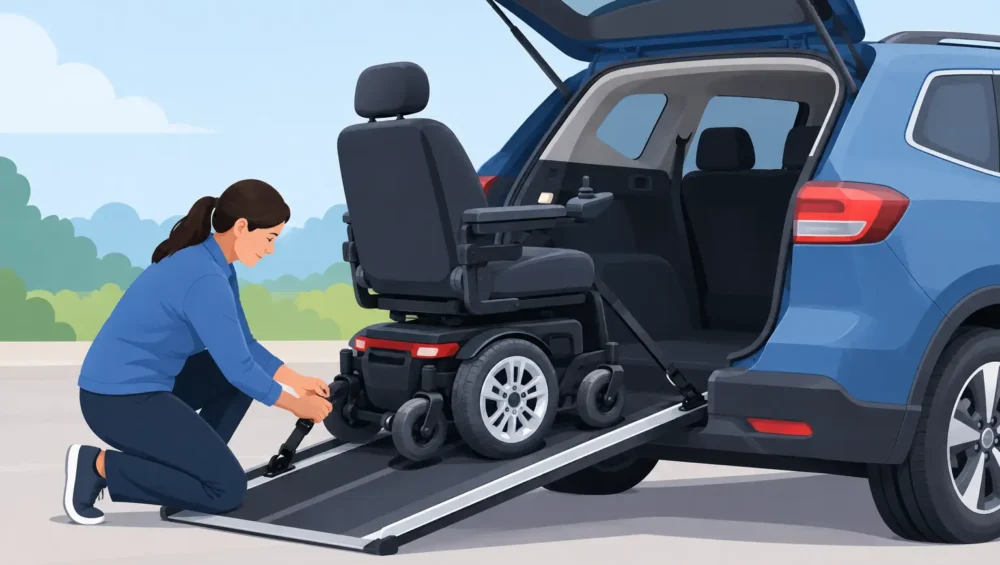
When loading, use your legs rather than your back and keep the chair close to your body. Two people should lift if the chair is awkward, bulky, or beyond a comfortable one-person weight. A portable ramp can reduce lifting, but it must be rated for the chair’s total weight, including battery and accessories.

Once inside the vehicle, the chair should not be free to roll or slide. Position it flat and secure it with rated tie-down straps connected to solid vehicle anchor points. Avoid attaching straps to moving parts, armrests, the joystick, or removable footplates. The chair should remain stable during braking, turns, and uneven road surfaces.

When a Vehicle Lift Is the Better Choice

A vehicle lift allows a power chair to travel without repeated lifting and folding. It can be a practical long-term investment for users of full-size power chairs or caregivers who should not be lifting heavy equipment.

Platform lifts carry the chair on an exterior or interior platform. They are convenient because the chair can usually stay assembled, but they add length and weight to the vehicle. Exterior lifts also expose the chair to rain, road dust, and heat, so a fitted weather cover is essential.

Hoist-style lifts use a powered arm to raise the chair into a trunk, SUV cargo area, or van. They keep the chair protected inside the vehicle, though they require enough interior clearance and a suitable mounting position. Some chairs must be partially disassembled or have the seat repositioned before loading.

For either system, check three ratings: the lift’s maximum capacity, the vehicle’s carrying capacity, and the chair’s actual travel weight. That travel weight includes batteries, cushions, bags, oxygen holders, and other accessories. A lift should never operate at or beyond its stated limit.

Secure the Chair for Every Journey

Securing a power chair is not only about preventing scratches. A chair can become a dangerous projectile in a sudden stop if it is not restrained correctly.

Use a purpose-designed docking system or four-point tie-down system when the chair is transported inside a van. Secure the frame at manufacturer-approved locations, with the chair powered off and the drive system in the recommended transport mode. Do not rely only on the parking brake.

If the passenger remains seated in the power chair while riding in an accessible vehicle, the setup requires additional care. The chair must be approved for occupied transport, and the vehicle must use an appropriate occupant restraint system. A standard lap belt around the wheelchair user is not a substitute for properly positioned vehicle-grade restraints.

For a chair stored in a trunk or cargo area, inspect straps before each trip. Replace straps with fraying, corrosion, damaged hooks, or unreliable buckles. It takes less than a minute to check them, and it can prevent a costly repair or injury.

Prepare the Battery for Road Trips and Flights

Battery preparation affects both safety and convenience. For road travel, charge the chair fully before leaving, then bring the correct charger. Avoid using an unapproved charger or plugging into questionable power sources, as this can damage the battery or controller.

Heat is a common concern. Never leave a power chair or loose battery in a vehicle for long periods during very hot weather. High temperatures can shorten battery life and may affect performance. If you are stopping for several hours, bring removable batteries indoors whenever practical.

Air travel has separate rules, especially for lithium-ion batteries. Airlines may limit battery size, require removable batteries to be carried into the cabin, or ask for terminals to be protected from short circuiting. Contact the airline before booking and again before departure. Provide the chair’s make, model, battery chemistry, watt-hour rating, weight, and folded dimensions.

At the airport, label the chair with your name and phone number. Carry clear instructions for placing the chair into freewheel mode, folding it, and protecting the joystick. Photographs of the chair before check-in can also help document its condition should damage occur during handling.

A Simple Pre-Trip Check

Before leaving, take a few minutes to confirm that the chair is charged, the tires are in good condition, and the joystick is protected. Bring the charger, key, any required tools, and a contact number for service support.

For longer journeys, it is wise to pack a small mobility kit with a tire pump if applicable, spare fuses if recommended for your model, a weather cover, and copies of battery information. These items are especially useful when traveling with a chair that is essential for daily movement.

If you are choosing a chair with transport in mind, test the full process before purchase. At a showroom, do more than sit in the chair. Fold it, lift it if appropriate, measure it against your vehicle, and ask how its battery and parts are supported. Vechair can help customers compare lightweight, compact, and higher-capacity designs with real transport needs in mind.

The best setup is the one that makes leaving home feel possible rather than complicated. When loading and securing the chair becomes a safe routine, every trip can begin with more confidence and less worry.

Electric Beds That Make Care Safer at HomeCategoriesUncategorized

Electric Beds That Make Care Safer at Home

A bed can become the center of someone’s day when getting up, changing position, eating, recovering, or receiving care is difficult. That is where electric beds can make a meaningful difference. Rather than asking a person with limited mobility to struggle against a flat mattress, an adjustable bed can bring the body into a more comfortable position at the touch of a button.

For families, the benefit is not only comfort. The right bed can make transfers safer, reduce the physical strain on caregivers, and help a loved one retain more control over everyday routines. The best choice is not always the bed with the most functions. It is the one that fits the user’s condition, the caregiver’s needs, the room, and the level of support required now and in the months ahead.

What Electric Beds Are Designed to Do

Electric beds, often called electric hospital beds or homecare beds, use a powered motor system to adjust the sleeping surface. Most models allow the backrest and leg section to rise or lower independently. The entire bed may also raise and lower in height, depending on the design.

These movements address real daily challenges. Raising the backrest can support reading, meals, conversations, medication, and easier breathing for some users. Elevating the legs may help a person rest more comfortably when they have swelling or fatigue. A height-adjustable base can bring the mattress closer to wheelchair-seat height, helping make a transfer more controlled for both the user and caregiver.

A good electric bed is not simply a more advanced bedroom item. It is care equipment designed to reduce unnecessary effort. For someone recovering after surgery, it may support a temporary period of limited movement. For an older adult or a person living with a long-term condition, it can become part of a safer, more independent daily routine.

Choosing Electric Beds for the Person, Not Just the Room

It is tempting to begin with the available floor space or a preferred appearance. Those details matter, but the person using the bed should guide the decision first. Start by considering how independently they can move, sit up, stand, and transfer.

When height adjustment matters most

A high-low function is one of the most useful features for care at home. When the bed lowers, a user may find it easier to place their feet securely on the floor before standing. When it rises, caregivers can assist with washing, dressing, changing bedding, or repositioning without constantly bending at the waist.

This feature is especially valuable where a family member provides regular care. Repeated lifting and awkward reaching can cause caregiver injuries over time. A bed that adjusts to a practical working height is an investment in safer care for everyone involved.

Backrest and leg adjustments for everyday comfort

A backrest that rises smoothly can help a person move from lying down to a supported seated position without relying entirely on someone else. Combined backrest and knee adjustments can also reduce the tendency to slide downward in bed, which is uncomfortable and can make repositioning harder.

Still, more movement is not automatically better. A user with particular pain, joint limitations, poor trunk control, or circulation concerns may need specific positioning advice from a clinician. Electric functions should support an existing care plan, not replace medical guidance.

Bed width, length, and weight capacity

The mattress platform needs to give the user enough room to turn and rest without making the room difficult to navigate. A narrow bed can be practical in a compact room, while a wider platform may provide greater comfort for larger users or those who need assistance with repositioning.

Always check the stated safe working load rather than assuming a bed is suitable because it looks strong. The total load may include the user, mattress, bedding, accessories, and any pressure-relief surface. For bariatric users, choosing a purpose-built model with an appropriate capacity is essential for stability, durability, and safe operation.

Safety Features That Deserve Close Attention

A powered bed should make care feel calmer, not introduce new worries. Look carefully at the features that protect the user during normal use, especially if they will spend long periods in bed or use the controls independently.

Side rails can help some users feel more secure when changing position or sleeping. However, rails are not right for every person. Someone who is confused, restless, or likely to attempt climbing over them may face a greater fall risk. The rail design, gaps, height, and the user’s abilities all need to be considered together.

A lockable caster system is equally important. The bed should remain stable during transfers, care tasks, and normal use, then move only when it is intentionally unlocked. Check that the controls are easy to reach and understand. A simple handset with clearly marked buttons is often more useful than a complicated controller with features the user will never use.

Power-outage planning also matters. Ask whether the bed includes a battery backup or a manual emergency lowering function. This is particularly important for users who cannot safely remain in a raised position if household power is interrupted.

The Mattress Is Part of the Care System

An electric bed frame and mattress must work together. A standard household mattress may not flex correctly with an articulated base, and a mattress that bunches or leaves large gaps can affect comfort and safety.

The right mattress depends on the user’s needs. A foam mattress may suit someone who needs everyday comfort and moderate support. A pressure-relief mattress may be more appropriate for a person who spends extended time in bed, has fragile skin, or is at risk of pressure injuries. For higher-risk users, caregivers should seek clinical advice on turning schedules, skin checks, and appropriate pressure management.

Do not overlook mattress height. A very thick mattress can change the effective height of side rails and make transfers less predictable. It should fit the platform securely and allow the bed’s functions to operate without restriction.

Plan the Room Before Delivery Day

An electric bed needs more than a space against the wall. Measure the room, doorways, hallways, and any turns that delivery teams must navigate. Leave enough clearance for caregivers to work on both sides where possible, and ensure there is a safe route for a wheelchair, walker, or hoist if one is used.

Place the bed near a reliable power outlet, but keep cables organized and away from walking paths. Extension cords and overloaded power strips are poor long-term solutions around medical equipment. Consider lighting too. A reachable bedside lamp or night light can make nighttime toileting and transfers safer.

Think about the routine around the bed. Is there room for a bedside table, medication supplies, a wheelchair, and a caregiver chair? Can the user see and reach what they need? Small practical details often determine whether equipment supports independence or creates frustration.

Service and Support Are Part of the Purchase

Electric beds have motors, control systems, moving joints, and casters. Like any piece of care equipment, they need correct installation, sensible use, and access to support if something goes wrong. A low price can become costly if replacement parts, repairs, or knowledgeable assistance are difficult to obtain.

Before buying, ask who will assemble the bed, demonstrate the controls, and handle future servicing. Confirm the warranty terms and ask what is covered for motors, handsets, batteries, and structural components. It is also wise to ask whether spare parts are available locally and how quickly service can be arranged.

At Vechair, the same practical approach used for mobility equipment applies to homecare solutions: match the equipment to the person, explain how it works clearly, and make sure support remains available after delivery. A hands-on demonstration can be especially reassuring for first-time buyers and caregivers who are unsure which functions they will use most.

A Better Night Can Start With a Better Position

The right electric bed does not remove every challenge of caring for someone with reduced mobility. What it can do is make the daily moments less demanding: sitting up for breakfast, settling after a tiring afternoon, transferring to a wheelchair, or helping a parent get comfortable before sleep.

Choose a bed that gives the user dignity, gives caregivers safer working conditions, and fits the reality of the home. When those three needs are considered together, better rest becomes more than a comfort – it becomes a steadier foundation for daily life.

How to Use Patient Hoists Safely at HomeCategoriesUncategorized

How to Use Patient Hoists Safely at Home

A transfer should never feel like a test of strength. When someone cannot safely stand, pivot, or bear weight, trying to move them by hand can put both people at risk of a fall, skin injury, or back strain. Learning how to use patient hoists properly turns a difficult daily task into a more controlled, dignified routine.

A patient hoist, also called a patient lift, supports a person in a sling while a caregiver moves them between a bed, wheelchair, commode, or chair. It can protect the caregiver’s body while helping the person being transferred feel secure and included in their own care. However, a hoist is only as safe as the setup, sling choice, and technique behind it.

Start With the Right Hoist and Sling

Before the first transfer, confirm that the equipment is suitable for the person and the space where it will be used. Mobile floor hoists are common for home care because they can move between rooms with enough clear floor space. Ceiling hoists may suit a fixed room setup, while sit-to-stand hoists are designed for people who can bear some weight, hold on, and follow instructions. They are not a substitute for a full-support hoist.

The sling matters just as much as the lift. A full-body sling supports the back, thighs, and often the head, making it a common option for people with limited trunk control. Toileting slings allow more access for clothing adjustments but provide less coverage. Some people need a hammock-style sling, a divided-leg sling, or a specialized option for amputees or larger body sizes.

Check the safe working load on both the hoist and the sling. The lower rating sets the limit. A 440-pound hoist does not make a 330-pound sling safe for a 400-pound user. The person’s comfort, body shape, level of muscle control, and clinical needs also affect sling selection. If there is any uncertainty, ask a qualified therapist, nurse, or trained equipment specialist to assess the setup before use.

How to Use Patient Hoists: Prepare Every Transfer

Rushing is where preventable mistakes begin. Give yourself time, explain what is about to happen, and make sure the person is comfortable with the plan. Even a person with limited speech may respond to a calm explanation and clear cues.

Before using the hoist, complete four essential checks:

  • Inspect the sling for tears, worn stitching, stretched loops, damaged clips, or signs of contamination.
  • Confirm the hoist battery is charged, the emergency stop is released, and the handset raises and lowers correctly.
  • Clear rugs, cords, footstools, pets, and other obstacles from the transfer route.
  • Check that the destination surface is ready, stable, and at an appropriate height.

For a transfer from bed to wheelchair, place the wheelchair close to the bed with the brakes on. Move or remove the footrests so they do not catch the person’s legs. If transferring to a recliner or commode, make sure it cannot roll, tip, or slide. A bed that is too low may make sling positioning harder, while a bed that is too high can leave the person suspended unnecessarily when moving away.

Never use a hoist on a steep slope, across an uneven outdoor surface, or with a low battery that may stop mid-transfer. A mobile hoist needs room for its base legs to open beneath or around the bed, chair, or wheelchair. Measure your furniture and pathways before choosing equipment, particularly in compact homes.

Position the Sling With Care

Sling placement should be comfortable and symmetrical. If the person is in bed, roll them gently onto one side using safe handling techniques. Fold or position the sling behind their back, then roll them onto the other side and pull the remaining section flat. Avoid leaving wrinkles beneath the person, as these can cause discomfort and increase pressure on fragile skin.

Bring the leg sections under each thigh. Depending on the sling design and clinical recommendation, the straps may cross between the legs or attach on the same side. Follow the sling label and its instructions exactly. Crossing straps can improve security for some divided-leg slings, but it is not correct for every model or every user.

When lifting from a wheelchair or chair, lean the person forward only if they can do so safely. Slide the back of the sling down behind them as far as possible, ideally to the tailbone area, then guide the leg sections into place. Never pull forcefully on a person’s arms or shoulders to position the sling.

Check that the sling is not pressing on wounds, feeding tubes, catheters, or painful joints. For users with pressure injuries, contractures, recent surgery, severe osteoporosis, or uncontrolled spasms, a clinician should provide specific transfer guidance.

Attach, Lift, and Move Slowly

Wheel the hoist into position with its base legs opened as required for stability. Center the boom over the person rather than pulling them sideways toward it. Lower the spreader bar until the loops or clips can be attached without strain.

Attach each sling strap to the correct hook or connection point. Take a deliberate second look: the left and right sides should match, the straps should not be twisted, and every attachment must be fully engaged. Keep the person’s arms inside or outside the sling according to its instructions and their comfort needs.

Raise the hoist slowly until the sling becomes taut, then pause. This is the best moment to check that the person feels secure and that the sling is supporting the thighs, back, and head as intended. If anything looks uneven or feels uncomfortable, lower the person back down and correct it. Do not try to adjust major sling placement while someone is fully suspended.

Once the lift is correct, raise only high enough to clear the surface. Keep one hand near the person if needed for reassurance and to prevent unwanted swinging, but do not manually carry their weight. Move the hoist slowly by its handle, walking rather than pulling with your back. Avoid sudden turns.

With a mobile floor hoist, it is often safer to move the person with the base legs in their recommended position rather than widening or narrowing them while the person is suspended. Follow the manufacturer’s instructions for that specific model. Brake guidance can also differ: generally, the hoist’s casters should remain unlocked during lifting so the lift can find its center of gravity, while the wheelchair or bed should be braked. Always follow the instructions supplied with your equipment.

Lower Into Position Without Rushing

Align the person over the center of the wheelchair, chair, commode, or bed. Lower them slowly, using small adjustments to guide their hips toward the back of the seat. Ask them to lean back or place their hands where appropriate if they are able. Make sure clothing and skin are not caught beneath them.

Once their weight is fully supported by the destination surface, release the sling straps and move the hoist away. Remove the sling only if it is comfortable and practical to do so. In some seating situations, a suitable sling may remain in place for a limited period, but this depends on the sling material, the person’s skin condition, and professional advice. Never leave a person sitting on thick, folded, or wrinkled sling fabric.

After the transfer, check their posture. Their hips should be positioned well back, feet supported if seated in a wheelchair, and head comfortably aligned. Ask whether they feel any pulling, pinching, or pain. A successful transfer is not just one that gets from point A to point B. It is one that leaves the person stable, comfortable, and confident.

Common Mistakes That Put Transfers at Risk

The most serious error is using a hoist without training. Reading instructions is essential, but hands-on guidance from a healthcare professional or trained equipment provider is especially valuable for first-time caregivers. Practice with supervision before transferring someone who is frail or medically complex.

Do not exceed weight ratings, improvise with a bedsheet instead of an approved sling, or use a sling with damaged labels or hardware. Do not leave someone unattended while suspended, even for a moment. Avoid lifting by the sling straps alone, and never attempt to catch a falling person during a transfer. Guide them down safely if possible and call for help.

Equipment maintenance also deserves attention. Charge batteries as directed, clean the sling according to its care label, and arrange inspection or servicing if you notice unusual noises, hydraulic problems, loose parts, or inconsistent lifting. Reliable equipment and available spare parts are part of safe long-term care, not an afterthought.

For families choosing their first transfer solution, a demonstration can make the decision much clearer. At Vechair, trained staff can help compare hoist styles, sling options, space requirements, and weight capacities so the equipment supports real daily routines rather than adding another worry.

The goal is not to make transfers look effortless on the first day. It is to make each one calmer, safer, and more familiar, until both caregiver and user can approach the next move with greater confidence.

Does Reclining Reduce Pressure Sores Safely?CategoriesUncategorized

Does Reclining Reduce Pressure Sores Safely?

A red mark over the tailbone after a long day in a wheelchair can be an early warning, not just a minor skin irritation. So, does reclining reduce pressure sores? It can help redistribute pressure for some wheelchair users, but reclining alone is not a complete pressure-injury prevention plan. The angle of the chair, the cushion, the user’s ability to reposition, skin condition, and time spent seated all matter.

For a person with limited mobility, comfort is not a luxury feature. It is part of safe daily support. A reclining wheelchair can make rest, caregiving, and pressure management easier when it is fitted and used correctly. It should never replace regular repositioning, skin checks, or advice from a qualified clinician.

Does Reclining Reduce Pressure Sores in a Wheelchair?

Reclining changes where body weight is carried. When the backrest moves rearward, some pressure may shift away from the buttocks and tailbone toward the back and thighs. This can provide welcome relief for a user who has been sitting upright for an extended period.

That benefit comes with an important limitation: a recline function does not automatically remove pressure from high-risk areas. Depending on the chair setup and the user’s posture, the pelvis may slide forward as the backrest reclines. This can create shear, a pulling force between the skin and the seat surface. Shear can damage skin and deeper tissue, especially around the sacrum and buttocks.

The practical answer is that reclining may reduce pressure in certain positions, but it must be paired with good positioning. A properly adjusted leg rest, supportive cushion, head support where needed, and a suitable recline angle all help the user remain stable rather than sliding downward.

Recline and Tilt Are Not the Same Function

These two features are often grouped together, but they work differently.

A recline function opens the angle between the seat and backrest. It can be useful for rest, personal care, changing clothes, managing fatigue, and giving the back a break. However, because the hip angle opens, recline can increase the risk of sliding if it is used without appropriate leg support or if the user has poor trunk control.

A tilt-in-space function keeps the seat-to-back angle largely the same while tipping the entire seating system backward. This tends to preserve the user’s posture and can redistribute pressure with less sliding. For many people at significant risk of pressure injuries, tilt is often a valuable feature for scheduled pressure relief.

Some users benefit from a chair that combines tilt and recline. Others need a simpler reclining wheelchair because of their daily routines, caregiver support, transfer needs, or budget. The right choice depends on the person, not simply on the number of powered functions.

Why Pressure Sores Develop

Pressure sores, also called pressure injuries or bedsores, develop when skin and underlying tissue are exposed to prolonged pressure, shear, friction, or moisture. Areas over bony points are particularly vulnerable. In a wheelchair, common risk areas include the tailbone, buttocks, hips, lower back, heels, and the backs of the thighs.

Risk rises when a person cannot independently shift weight, has reduced sensation, is underweight or medically frail, experiences incontinence, has diabetes or poor circulation, or spends many hours seated. A cushion that feels soft is not necessarily a pressure-relieving cushion, and a chair that looks supportive may still be a poor fit for the user’s body shape.

This is why an occasional recline is not enough. Pressure management works best as a routine built around movement, positioning, equipment, and observation.

How to Use a Reclining Wheelchair More Safely

The safest recline position is one that supports the whole body. Before reclining, make sure the user is sitting fully back in the chair with the pelvis positioned as far back as possible. Feet should be supported, and the cushion should be correctly placed without folds, gaps, or added layers that alter the seating surface.

When the backrest moves, elevate or adjust the leg rests when appropriate so the user is less likely to slide forward. The goal is to maintain contact and support across the body, not to leave all weight concentrated at the tailbone. After returning upright, check whether the user has slipped forward and needs repositioning.

For people who can move independently, regular weight shifts remain essential. A clinician can recommend the right schedule and technique based on the person’s condition. For those who cannot reposition alone, caregivers should follow an individualized turning and pressure-relief plan. Never assume that a user is comfortable simply because they do not complain, especially if they have reduced sensation.

A recline feature is also useful for short rest periods during the day. It can reduce fatigue and make personal care less demanding, but long periods in one reclined position still require monitoring. Pressure can simply move to a different area of the body.

The Cushion Matters as Much as the Chair

A high-quality wheelchair cushion is one of the most important parts of pressure management. Foam, gel, air-cell, and contoured cushions each have different strengths. The best option depends on skin risk, posture, weight, transfer ability, heat and moisture concerns, and how the chair is used indoors or outdoors.

For example, an air-cell cushion may offer strong pressure redistribution but requires regular inflation checks. A contoured foam cushion can provide stable positioning and easier everyday use, though it may not suit someone with very high pressure-injury risk. A cushion must also match the chair’s seat width and depth. An undersized or oversized cushion can interfere with posture and make pressure problems worse.

Avoid adding thick household pillows, folded blankets, or multiple cushions unless a seating professional has advised it. These additions can make the user unstable and create uneven pressure. They can also reduce the effectiveness of a properly designed medical cushion.

Daily Skin Checks Catch Problems Early

The skin should be checked every day, especially after a long period in the chair. Look for redness that does not fade after pressure is relieved, purple or darkened areas, warmth, swelling, tenderness, blisters, open skin, or changes in texture. On darker skin tones, pressure damage may appear as a darker, ashy, purple, or unusually shiny area rather than bright red.

If a mark does not fade, if skin is broken, or if there is pain, drainage, fever, or an unusual odor, contact a healthcare professional promptly. Do not massage a red area. Massage can further damage vulnerable tissue.

Caregivers should also watch for quieter signs: a person avoiding sitting, becoming restless in the chair, or reporting burning or numbness in a new spot. These details can help identify a seating issue before it becomes a wound.

Choosing a Reclining Chair for Pressure Management

When comparing reclining electric wheelchairs, look beyond the recline button. Consider whether the chair provides stable posture support, adjustable footrests, an appropriate seat size, a compatible pressure-relieving cushion, and sufficient weight capacity. For users who spend most of the day seated, professional assessment is especially worthwhile.

A test drive can reveal problems that specifications alone cannot show. Does the pelvis stay back while reclining? Are the feet supported? Can the user reach the controls comfortably? Is the head and trunk well supported? Can a caregiver operate the chair and assist with transfers safely?

At Vechair, this practical assessment is a key part of choosing a mobility solution. A chair should support independence, but it should also fit the user’s daily life, body, home environment, and care needs. Reliable service and available spare parts matter as well, because a wheelchair that cannot be adjusted or repaired when needed cannot provide consistent support.

When to Ask for Professional Guidance

A doctor, occupational therapist, physiotherapist, wound-care nurse, or seating specialist should guide the setup for anyone with an existing pressure injury, repeated skin redness, inability to reposition independently, major changes in weight, severe postural asymmetry, or reduced sensation. They can assess whether recline, tilt, a different cushion, or a custom seating system is needed.

The right wheelchair position should feel secure, not like the user is gradually sliding out of the seat. When recline is combined with correct support, regular pressure relief, attentive skin care, and a chair fitted to the individual, it can be a meaningful part of staying comfortable and protecting skin every day.

Can Power Chairs Fit Cars? What to Measure FirstCategoriesUncategorized

Can Power Chairs Fit Cars? What to Measure First

A power chair can make everyday outings feel possible again, but the first practical question is often the same: can power chairs fit cars? The honest answer is yes, many can, but not every power chair will fit every vehicle. A lightweight folding model may travel easily in a sedan trunk, while a larger reclining or heavy-duty chair may need an SUV, van, lift, or trailer.

The right choice starts with more than the chair’s weight. You need to match its folded dimensions, lifting method, battery type, and your own physical ability with the vehicle you use most. Getting these details right means less strain for caregivers, safer loading, and more confidence when it is time to leave home.

Can Power Chairs Fit Cars? It Depends on the Chair and Vehicle

Compact folding power chairs are designed with car travel in mind. Once folded, many can be lifted into a hatchback, crossover, SUV, or larger sedan trunk. Carbon fiber and magnesium designs are particularly useful for people who want a lighter chair without giving up powered independence.

However, a chair described as “portable” is not automatically easy for every person to load. A 40-pound chair may be manageable for one family member and too heavy or awkward for another. The shape matters too. A chair that weighs less but has a bulky folded frame can be harder to position through a narrow trunk opening than a slightly heavier chair that folds into a neat rectangle.

Larger power chairs bring different benefits. Reclining seats can improve comfort and pressure relief. Off-road models offer stability on uneven paths. Bariatric chairs provide wider seating and higher weight capacity, sometimes supporting users up to 440 pounds. These features are valuable, but they typically increase the chair’s size and weight. For regular car travel, they often require a vehicle lift or a more spacious vehicle.

Measure the Vehicle Before Choosing a Chair

Do not rely on the appearance of the trunk alone. Measure the usable space with the trunk open, then compare it with the power chair’s fully folded measurements. Manufacturers may list overall dimensions, but what matters is the size of the chair in its transport position.

Start with the width and height of the trunk opening. This is the point where many buyers run into trouble. A chair might fit inside the cargo area but not pass through the opening because of the trunk lip, rear lights, or angled hatch. Next, measure the cargo floor length and depth. If the chair needs to lie flat, account for the seatback, footrest, joystick, and any parts that cannot be removed.

Also consider the height of the cargo floor from the ground. An SUV may offer more space than a sedan, yet its cargo floor can be higher. That means a heavier chair has to be lifted farther. A low sedan trunk can sometimes be easier to load if the folded chair is compact enough to pass through the opening.

Bring these four measurements when comparing chairs:

  • Trunk or hatch opening width
  • Trunk or hatch opening height
  • Usable cargo depth and floor width
  • Cargo floor height from the ground

If possible, measure with the items you normally keep in the car, such as a walker, oxygen equipment, groceries, or a child’s seat. Mobility should fit real life, not just an empty showroom measurement.

Check the Vehicle Payload Too

Vehicle payload is the maximum total weight a vehicle can safely carry, including passengers, luggage, the power chair, and accessories. Most passenger vehicles can carry a lightweight folding chair without concern, but it is still wise to check the label inside the driver’s door frame or the owner’s manual.

This becomes more relevant with a heavy power chair, a vehicle lift, and multiple passengers. Never overload the vehicle or place a chair where it can shift during driving. A properly secured chair protects everyone in the car.

Choose the Right Transport Method

For many families, manual loading is the simplest option. It works best with a compact folding power chair that has a realistic lifting weight for the person handling it. Some chairs can be folded and lifted in one piece, while others allow the battery to be removed first, reducing the weight of the frame.

A portable ramp may help roll a chair into certain vehicles, but the angle must be safe and the chair must be compatible with the ramp setup. Ramps are not a shortcut for lifting into a standard trunk. They are more commonly useful with vans, low-floor vehicle entrances, or accessible vehicle conversions.

A hitch-mounted platform lift can carry a larger chair outside the vehicle. This keeps the cargo area free, but it adds length to the car and exposes the chair to weather and road debris. It must be matched to the chair’s weight, the vehicle’s towing or tongue-weight rating, and local visibility requirements for lights and license plates.

Interior lifts and hoists are another option. These systems can lift a folded chair into an SUV, van, or hatchback with less physical effort. They can be an excellent solution for a caregiver with back or shoulder concerns, although they take up cargo space and should be professionally fitted.

For full-size power chairs, a wheelchair-accessible van may be the most comfortable long-term answer. This is a larger investment, but it allows the user to remain seated in the chair or drive into the vehicle depending on the conversion. It is often the better choice when transfers are difficult or the chair is needed for all-day seating support.

Weight Is More Than a Product Specification

It is tempting to focus only on the lightest number. Yet the best travel chair is not always the lightest chair on the page. A very light model may have a smaller battery range, a lower user-weight capacity, or less suspension for rough sidewalks. A stronger model may be worth the extra pounds if it delivers the seating comfort, stability, and daily range you need.

Think about the full journey. Can the chair travel from the front door to the car over your driveway? Can it handle the shopping center, clinic, park, or family gathering after it is unloaded? Can the person loading it do so repeatedly without risking injury?

For regular car users, a chair with a folding frame, manageable lift weight, removable lithium battery, and simple controls usually offers the best balance. For outdoor users or larger individuals, it may be better to choose a more capable chair and invest in the right vehicle transport equipment rather than compromising on safety or comfort.

Battery Rules Matter When You Travel

Most modern portable power chairs use lithium batteries because they are lighter and more energy-efficient than traditional lead-acid batteries. For road trips, keep the charger accessible and avoid leaving batteries in extreme heat inside a parked vehicle.

If you plan to fly, battery regulations are different from car travel. Airlines commonly require removable lithium batteries to be carried into the cabin, with limits based on watt-hours and airline policy. Confirm requirements before booking rather than assuming a battery approved for everyday use will be accepted for air travel.

For car transport, turn the chair off, protect the joystick from being knocked, and secure loose accessories. If the battery is removable, make sure it is locked in place or stored safely according to the chair manufacturer’s instructions.

Test the Fit Before You Buy

A tape measure is essential, but a real test fit is better. Fold the chair yourself. See whether the controls, footrest, or armrests need adjustment. Practice lifting it with the same person who will load it at home. Then place it into the actual vehicle if possible.

This hands-on check often reveals details that specifications cannot: whether the trunk lip catches the frame, whether the hatch closes without pressure, or whether a caregiver can maintain a safe lifting posture. At Vechair, a guided test drive and product demonstration can help families compare compact, carbon, magnesium, reclining, and heavy-duty options based on the way they actually travel.

A power chair should expand where life can take you, not create a new barrier at the parking lot. Choose a chair and transport setup that feels safe on an ordinary Tuesday, because that is what makes spontaneous coffee visits, appointments, and family outings easier to say yes to.